
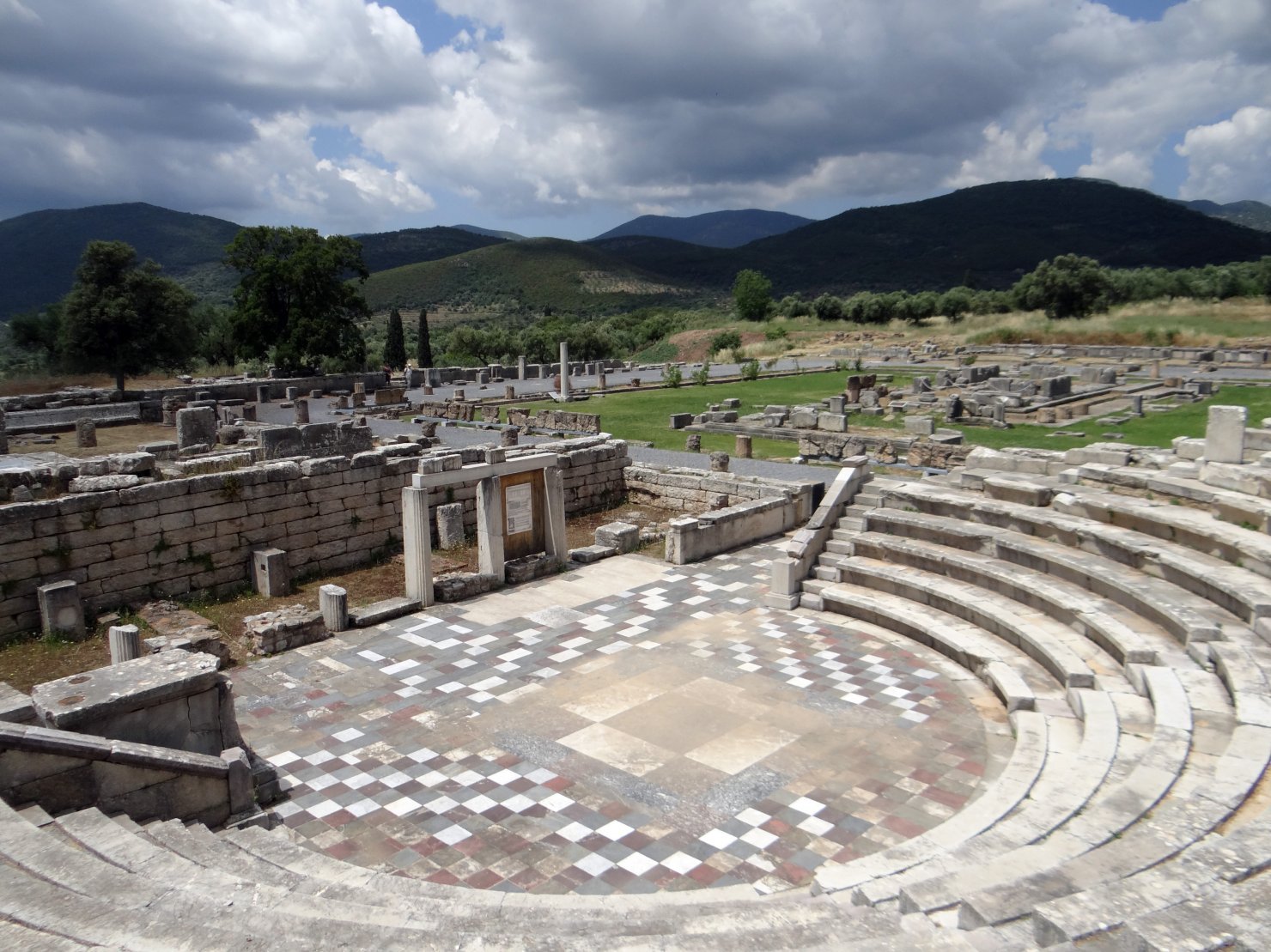
The 400-acre archaeological park contains 18,000 movable finds from antiquity, restored monuments, well-designed internal routes, concise and easy-to-understand descriptions, and even shaded resting spots under olive trees for a short break during the visit. The goal of Petros Themelis, whose life has been closely connected with Ancient Messene, was not only to excavate the ancient city, but also to make the archaeological park, as he noted during our conversation, “a driving force for the economic, social and environmental development of the region. Monuments from every era are stable, immovable and indisputable timeless elements of our culture. The monuments of Ancient Messene, and especially the spaces of viewing and listening — the Stadium, the Theatre and the Ecclesiasterion — have rediscovered their ancient function and once again felt the presence of living people.”
And indeed, while walking through the ancient city, you can feel the human presence that began in 369 BC and continued at least until Roman times. You see the coins in the public baths, the carved games of tic-tac-toe on the steps of the Gymnasium, you imagine young men competing in the Palaestra, and you form images in your mind of everyday life in the Agora and the Asclepieion, the center of public life in Ancient Messene. Yet even today, in the modern era, when you see so many restored monuments shining under the sun and spreading across a vast area, what is actually revealed to you is only 25–30% of the ancient city. It is estimated that many residential complexes and various other infrastructures still remain buried beneath the soil.
Entering the archaeological site, you will first encounter the Theatre, followed by the sanctuaries of the Agora and the Asclepieion, with its series of rooms that once housed statues of Apollo and the Muses, Heracles and Thebes with Epaminondas, Tyche and Artemis Phosphoros. You will also see the bath, the Bouleuterion and the Ecclesiasterion. Walking down the slope, you will find the urban villa on your left, and finally the Stadium and the Gymnasium, the Palaestra and the Mausoleum.
Ancient Messene is a living archaeological site, one that speaks both to the past and to the present. The Theatre and the Stadium are often used for events — even techno DJ Charlotte de Witte performed here, without an audience, in February 2021. Recently, a shelter was installed at a point of the Stoa around the Stadium, where art exhibitions will also be hosted. The archaeological park is in the final stage of highlighting its monuments, while the School of Architecture of the National Technical University of Athens is preparing the route lighting design and new visitor paths are being planned.
You will need about three hours for your visit, while it is also worth driving a few kilometers further up to see the Arcadian Gate, one of the two entrances to Ancient Messene — a provincial road passes directly beneath it. The museum exhibits statues, busts and objects from the excavations at the archaeological site, while 5 km away you will also find the beautifully restored Byzantine monastery of Andromonastiro. It was founded by Emperor Andronikos II, from whom it took its name, and is located in a lovely setting beside running waters.
Ancient Messene and its museum are open daily from 08:30 to 15:30. From April 1st, opening hours are extended. Entrance fee: €10. For information, call +30 27240 51201.
Andromonastiro is open daily from 08:00 to 15:00. For weekend visits, prior communication with the Ephorate of Antiquities of Messinia is required in order to arrange an appointment, at +30 27210 22534. From May onwards, the monastery is also open on weekends and public holidays during the same hours.